
Property management weekly report template
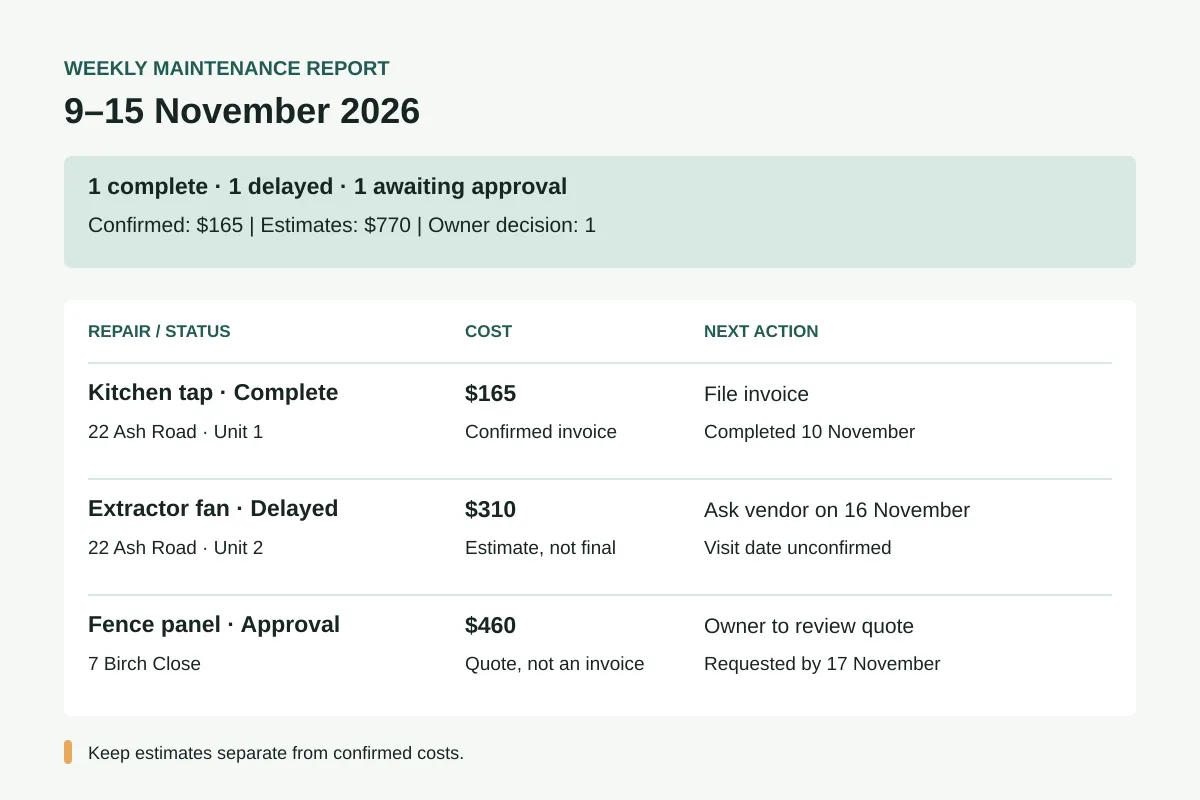
A property management weekly report template should put the reporting dates and current status first, then show each repair's progress, costs, delays and next action. For a small residential portfolio, a short summary followed by one block per repair gives the owner a useful weekly account. The template below focuses on maintenance; keep rent collection, occupancy and financial statements in separate sections or attachments if your reporting agreement requires them.
What should a property management weekly report include?
A weekly property management report should identify the owner, properties and reporting period, summarize current repair status, and show any decisions the owner needs to make. Each maintenance item needs the latest dated update, a clearly labeled cost and a next action assigned to someone.
Use this order:
- Period and scope: exact start and end dates, recipient and properties included.
- Status summary: completed, delayed and other open repairs, with mutually exclusive counts.
- Owner decisions: the quote or proposed work to review, the amount and the requested response date.
- Repair details: what happened, when, cost type, blocker and next step.
- Next update: when the owner will hear from you again.
Keep unresolved repairs visible even if nothing changed. “No vendor update received as of 15 November; manager to follow up on 16 November” is more useful than silently dropping the item.
Copy this blank weekly report template
Paste these fields into a document. Repeat the repair block for each relevant item, and delete empty categories. Prepare a separate report for each owner rather than sharing a portfolio-wide list.
Weekly maintenance report — [start date] to [end date]
Prepared for: [owner name]
Prepared by: [manager name]
Properties: [addresses / units belonging to this owner]
Currency: [currency]Status at [end date]: [number] complete; [number] delayed; [number] other open, including [number] awaiting owner approval.
Owner decision requested: [property, proposed work, quote amount and cost basis]. Please [specific decision] by [requested date]. [If none: No owner decision requested this week.]
[Property / unit] — [repair] — [current status]
What happened: [latest supported progress in plain language].
Dates: Reported [date]; last update [date]; completed [confirmed date, if applicable].
Cost: [amount and whether confirmed invoice, estimate, quote or unknown].
Delay / blocker: [known reason, if applicable].
Visit: [confirmed appointment, or date not confirmed].
Next action: [person] will [action] on / by [date].Cost summary: [amount] confirmed invoice costs; [amount] estimated or quoted, not final spending; [number] repairs with unknown costs. [State whether figures cover this week's invoices or all listed repairs.]
Next weekly update: [date].
Use “awaiting approval” only when a decision has actually been requested. A quote sitting in your inbox is not evidence that the owner has received it.
A filled example: one complete, one delayed, one decision
Say you manage 22 Ash Road and 7 Birch Close for one owner. This is a fictional week, covering 9–15 November 2026; all amounts are in USD.
Weekly status: Three listed repairs: one complete, one delayed and one awaiting owner approval. Confirmed invoice costs are $165. Outstanding estimates and quotes total $770; that is not an additional $770 spent.
Owner decision requested: Please review the $460 fence-panel replacement quote for 7 Birch Close by 17 November. The quote was emailed to the owner on 13 November. No contractor appointment has been booked.
Complete: kitchen tap at 22 Ash Road, Unit 1
The resident reported a dripping tap on 9 November. The plumber replaced the cartridge on 10 November and recorded a leak-free check that day. The invoice received on 12 November confirms a $165 cost.
- Status: Complete; completion date 10 November.
- Cost: $165 confirmed by invoice, received during this reporting period.
- Next action: Manager to file the invoice with the property's maintenance records on 16 November.
Delayed: extractor fan at 22 Ash Road, Unit 2
The fan fault was reported on 11 November. On 13 November, the vendor said the replacement motor was still on order. A new visit date has not been confirmed.
- Status: Delayed; latest vendor update 13 November.
- Cost: $310 estimate, not final.
- Next action: Manager to ask the vendor for the motor delivery status and a proposed visit date on 16 November.
That follow-up date is the manager's action, not a promised repair date.
Awaiting approval: fence panel at 7 Birch Close
A loose fence panel was reported on 12 November. The manager received a $460 replacement quote on 13 November and sent it to the owner that day for review.
- Status: Awaiting owner approval; replacement has not started.
- Cost: $460 quote, not an invoice.
- Next action: Owner asked to review the quote by 17 November. Manager to follow up on 18 November if no reply is received.
Next weekly update: 22 November, covering 16–22 November. If an appointment or approval is confirmed before then, update the source record so next week's report reflects the change.
Keep the cost summary from overstating spending
A cost summary should separate confirmed invoice amounts from estimates and unknowns. It should also say which period or set of repairs the amounts cover, so an old invoice is not presented as new spending every week.
| Cost label | What the owner can conclude | Example wording |
|---|---|---|
| Confirmed invoice | An invoice supports the amount; this does not by itself mean it has been paid | “$165 invoiced; payment status not recorded here” |
| Estimate or quote | This is the proposed or expected amount, not final spending | “$310 estimate; final invoice not received” |
| Unknown | No supported amount is available | “Cost unknown; assessment and quote requested” |
In the worked week, $165 + $310 + $460 equals $935, but calling $935 “spent this week” would be wrong. Report $165 in confirmed invoice costs and $770 in outstanding estimates and quotes. If the fan quote later changes, replace the old estimate rather than counting both versions.
Check these five things before sharing
- Recipient: Only this owner's properties are included. Remove unnecessary tenant contact details and private message history.
- Status: “Vendor contacted” does not mean booked. “Work attended” does not necessarily mean complete. Check the source notes and completion evidence.
- Dates: A next follow-up, expected delivery and confirmed appointment have different meanings. Label them separately.
- Counts: Count each repair once in the headline. Treat awaiting approval as part of open work, not an extra repair.
- Decisions: Give the owner the actual quote or supporting attachment, a specific request and a response date. Don't imply approval from silence.
Handle urgent incidents through your normal immediate response and communication process; the weekly report is the later summary, not a reason to wait.
If you need an email rather than a report document, use the copyable weekly landlord maintenance email template. It provides subject and body fields you can adapt to your own records.