
Contractor invoice higher than estimate? Tell the landlord
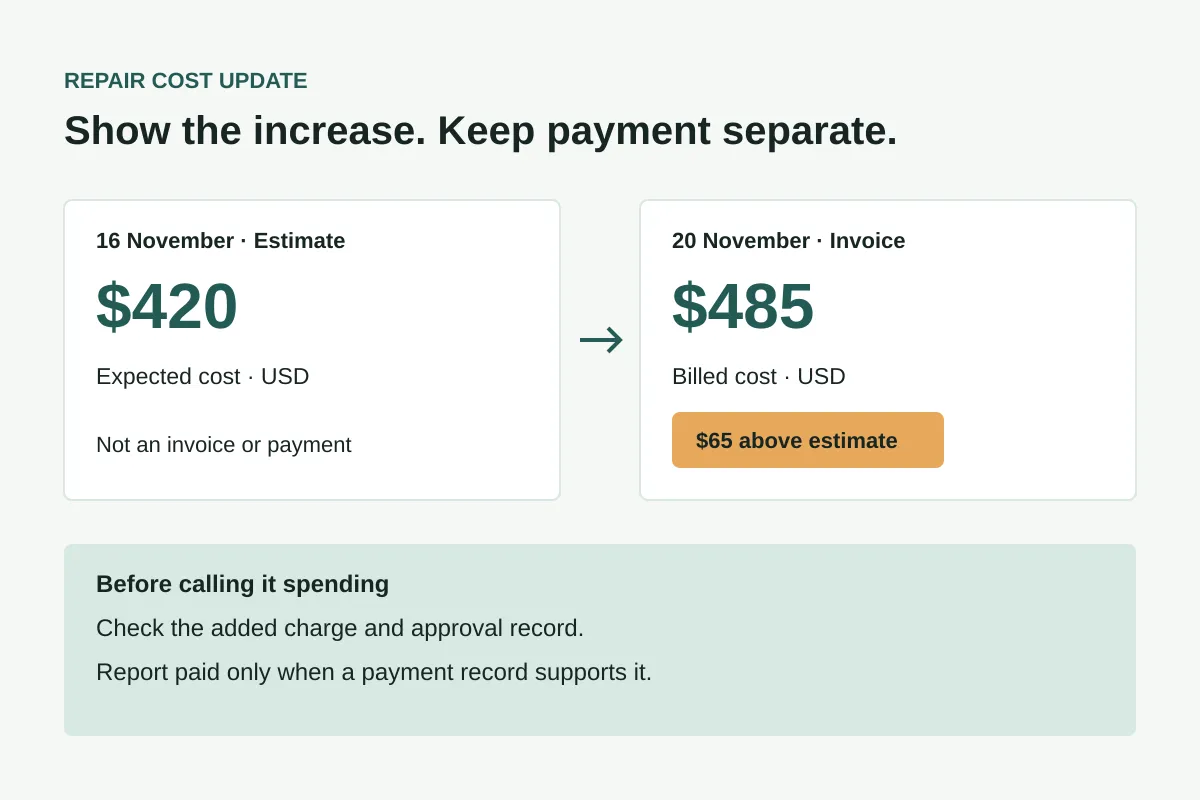
When a contractor invoice is higher than the estimate, tell the landlord the original amount, the billed amount, the difference and what explains it—or what you are still checking. Keep approval, repair completion and payment status separate. A higher invoice records a higher charge; it does not by itself prove the extra work was authorized or the bill was paid.
What to check when a contractor invoice is higher than the estimate
Compare the invoice with the original estimate and any later approved changes. Before describing the increase, make sure both totals cover the same work and use the same basis for tax, call-out fees and other charges.
Check these records:
- Original price basis: Was the document an estimate, a fixed quote or a price range? Keep its date, scope and exclusions beside the amount.
- Invoice details: Confirm the property, repair, invoice number and total. Identify the line items that account for the difference.
- Change record: Find the contractor's explanation and any written approval. Record who approved what amount and when; don't infer approval from silence.
- Repair evidence: Check the service note or other completion record. An invoice may arrive while a return visit or unresolved fault remains.
- Payment record: Check whether the invoice is unpaid, partly paid or fully paid. If you haven't checked, say “payment status not yet verified.”
An estimate is an expected price for proposed work. An invoice is a bill requesting payment. As GOV.UK's invoicing guidance explains, an invoice is different from a receipt, which acknowledges payment.
Whether a contractor is entitled to charge more is a separate question. The contract, price basis and applicable law matter; there is no universal percentage increase that a weekly update should treat as automatically acceptable. For your own approval or payment dispute, review the agreement with a qualified local adviser.
A worked repair update: $420 estimated, $485 invoiced
Say you manage 18 Maple Court for one landlord. A door-lock repair has these records; dates are in November 2026 and all amounts are USD:
| Date | Record | What it supports |
|---|---|---|
| 16 November | Contractor estimates $420 for the lock replacement | Expected cost, not a payment |
| 17 November | Landlord approves the described work at the estimated $420 | Approval of the recorded scope |
| 18 November | Contractor identifies a damaged strike plate; landlord approves an additional $65 in writing | A documented change, bringing the approved amount to $485 |
| 19 November | Service note records the replacement and a successful locking test | Completion supported by the service record |
| 20 November | Invoice arrives for $485, including a separate $65 strike-plate line | Billed amount and the reason for the increase |
| 22 November | Manager checks the payment ledger; no payment is recorded | Invoice unpaid as of the reporting date |
The difference is $485 minus $420: $65 above the original estimate. The extra charge matches the documented change. Keep both the original estimate and the change in the repair history, but use the invoice as the current billed amount in the weekly cost summary.
Here's how that repair can appear in the landlord's report:
Complete — door-lock repair, 18 Maple Court
Reporting period: 16–22 November 2026.
The contractor replaced the lock and strike plate on 19 November. The service note records a successful locking test.
Original estimate: $420, dated 16 November.
Invoice: $485, received 20 November—$65 above the estimate. The increase is the strike-plate replacement you approved in writing on 18 November.
Payment: Unpaid as of 22 November, according to the payment ledger.
Next action: The manager will process the invoice under the agreed payment procedure and record the payment reference. No further repair approval is requested.
If the extra charge is not yet explained
Report the amount received without presenting the increase as agreed. Say exactly which evidence is missing and what you will ask for next.
Using the same $420 estimate and $485 invoice, but without a supporting change record, the cost paragraph would read:
Invoice under review: The contractor's $485 invoice, received on 20 November, is $65 above the original $420 estimate. I have not found a recorded approval or an explanation for the additional charge. I will ask the contractor for an itemized explanation on 23 November and check it against the approved work. Payment status has not yet been verified. I will update you on 24 November, even if the difference remains unresolved.
Keep the repair's physical status on its own line. “Invoice under review” does not mean the repair is unfinished, and “repair complete” does not mean every billed charge has been checked.
If additional work is still proposed rather than already billed, make the request specific: “Please review the proposed $65 strike-plate replacement, which would bring the total to $485.” Attach the revised scope and price. Don't write that the landlord approved it until a supporting response is in the record.
Carry the invoice into next week's report without counting it twice
For the worked repair, the current billed amount is $485—not $420 plus $485. The estimate remains a comparison figure, not another charge.
If a payment record later confirms full payment of that same invoice on 25 November, next week's update can say:
Payment update — 23–29 November: The $485 invoice received last week was paid on 25 November. No additional repair charge is reported this week.
Label the summary's basis: invoices received during the week, payments made during the week, or current totals for listed repairs. Those answer different questions. For several repairs, use the weekly property management report template to keep the period and each repair's next action clear.
If the repair itself is still delayed, Mendora's personalized repair-delay landlord email lets you enter known facts, review the wording and copy it into your own email without signup. Keep the estimate and confirmed invoice amount in their separate fields, and explain any difference using your records.